

Vision Therapy in Pea Ridge
Seeing 20/20 isn't the same as seeing well. Vision is a skill — and like any skill, it can be trained. Vision therapy retrains how the eyes and brain work together to fix problems glasses alone can't.
What sets our vision therapy apart.
Seeing 20/20 isn't the same as seeing well. Vision is a skill — and like any skill, it can be trained. Vision therapy retrains how the eyes and brain work together to fix problems glasses alone can't.
Eye teaming & binocular vision
How well your two eyes work together — a common hidden cause of headaches and reading trouble.
Focusing (accommodation)
The ability to shift focus and sustain near work, critical for students.
Tracking & eye movements
Smooth tracking is essential for reading; poor tracking causes skipped words and lost place.
Amblyopia & strabismus therapy
Targeted programs for lazy eye and eye-turn — often more effective than patching alone.
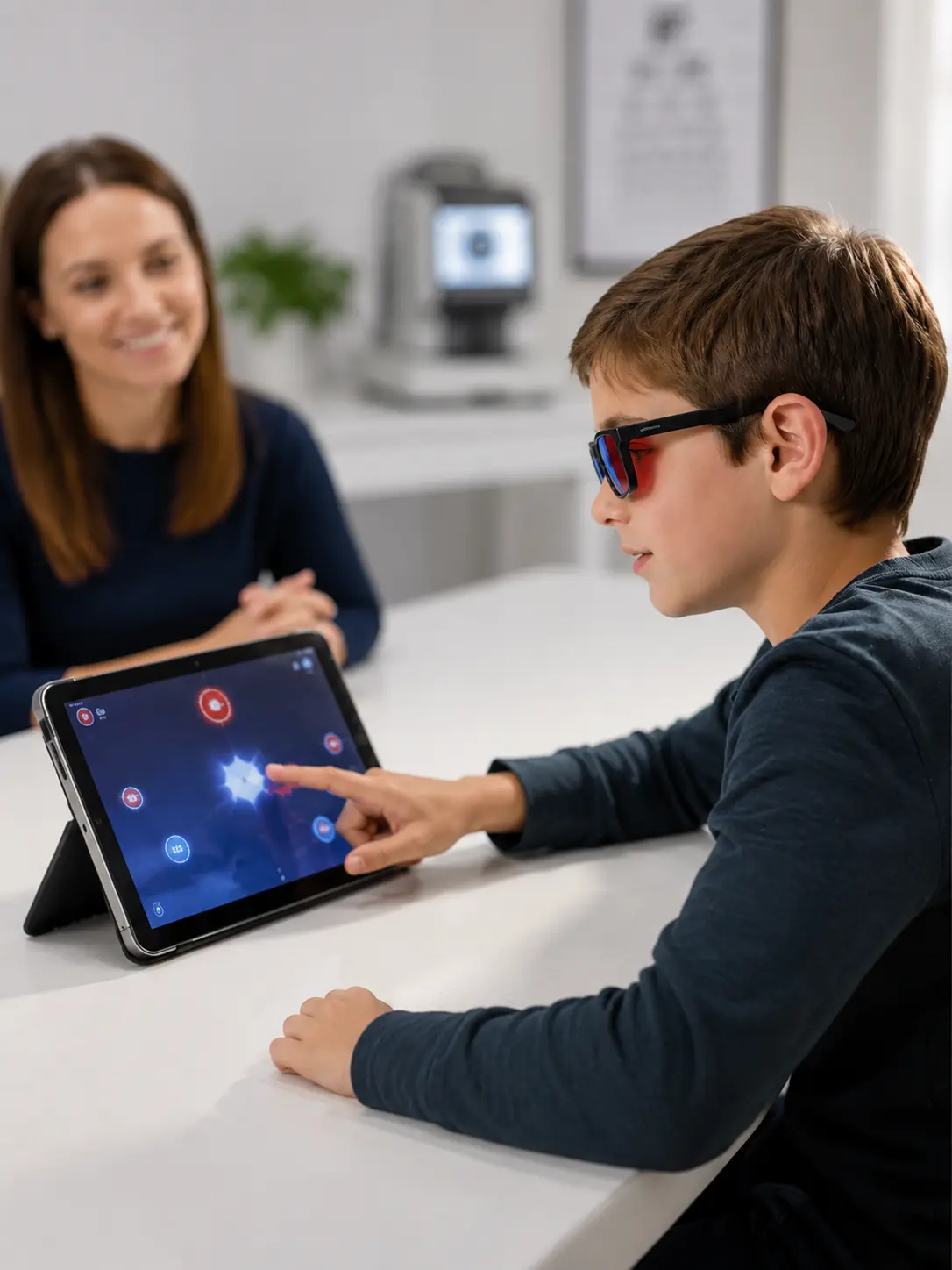
Your vision therapy visit.
Vision therapy starts with a specialized binocular vision evaluation — more in-depth than a routine exam. If therapy is appropriate, we build a customized program of in-office and at-home exercises, typically over several weeks to months, with progress tracked at each visit.
Seeing clearly and using vision well are different skills.
Vision therapy exists because 20/20 eyesight is only one piece of functional vision. Reading a page requires the eyes to aim at the same point, hold focus, and jump accurately from word to word hundreds of times per minute. When any of those skills is weak, the result rarely looks like a vision problem. It looks like a smart kid who hates reading, homework that takes twice as long as it should, words that seem to move or double, losing their place constantly, or fatigue and headaches after twenty minutes of near work.
The conditions behind these struggles have names: convergence insufficiency, where the eyes fight to team up at reading distance; accommodative dysfunction, where focusing power is weak or slow; amblyopia, the lazy eye that develops when the brain starts ignoring one eye; and strabismus, where an eye drifts. All are diagnosable with the right testing, and school screenings and routine acuity checks miss most of them.
Therapy itself works like physical therapy for the visual system. After a full evaluation maps exactly which skills are weak, a structured program of in-office sessions and home activities progressively retrains eye teaming, focusing, and tracking, with measurable re-testing along the way so progress is objective rather than a feeling. Programs typically run a few months depending on the diagnosis, and children are the most common patients, though adults with lifelong eye teaming problems and patients rebuilding skills after a concussion benefit too. For the concussion side, see our neurological vision care page.
If any of the struggles above sound like your child, the starting point is a pediatric eye exam with the functional testing included. Bring your observations from homework time. They are often the most useful diagnostic information in the room.
Common questions about vision therapy
Can vision therapy help my child's reading problems?+
Often, yes — when the issue is vision-based (eye teaming, tracking, or focusing problems). Many kids labeled as struggling readers actually have undiagnosed vision problems a school screening missed.
Does vision therapy work for adults?+
Yes. Adults benefit from vision therapy for eye-teaming problems, post-concussion recovery, and visual fatigue. The brain remains adaptable at any age.
Is vision therapy the same as eye exercises online?+
No. Vision therapy is doctor-supervised, individualized, and uses specialized equipment. Generic online 'eye exercises' aren't a substitute for a structured therapeutic program.
How long does vision therapy take?+
It varies by condition — many programs run a few months. We'll give you a realistic timeline after the evaluation and track measurable progress throughout.
Explore related services.
Ready to get started?
Book a vision therapy appointment online or call us directly. New patients welcome.
Let's see what good vision can do.
Book online in under a minute, or call us directly. New patients welcome.